Table of Contents
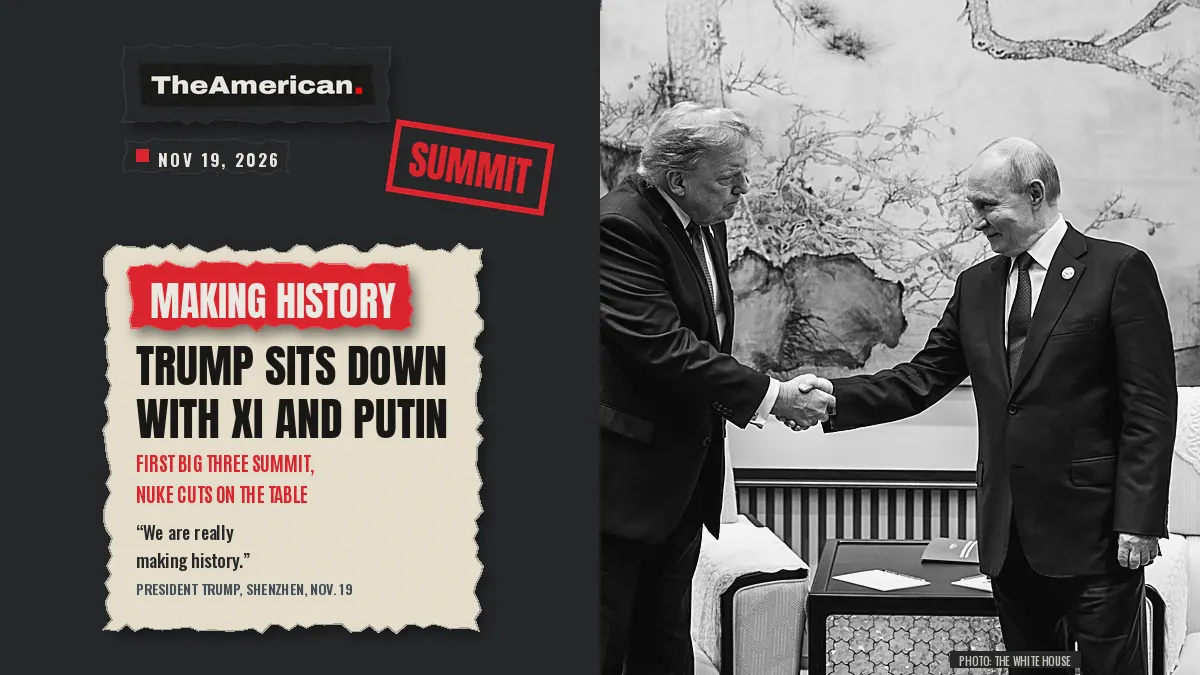
- President Trump, Chinese President Xi Jinping and Russian President Vladimir Putin held the first-ever three-way meeting of their countries' leaders Thursday in Shenzhen, China, on the sidelines of the APEC summit.
- Trump said the U.S., Russia and China, "the world's three largest nuclear powers by far," are "uniquely positioned" to discuss reducing the number of nuclear weapons on Earth.
- Putin said the three countries share interests in settling regional conflicts, "including obviously the conflict in Ukraine."
- Trump also raised keeping Iran from getting a nuclear weapon and said he would propose ways to protect the three countries' sovereignty from the International Criminal Court, Fox News reported.
Three men. One round table. Most of the world's nuclear warheads.
And the man who pushed nuclear cuts onto the agenda was the American.
President Trump sat down Thursday with Chinese President Xi Jinping and Russian President Vladimir Putin at Kylin Villa, a state-owned lakeside resort in the hills outside Shenzhen, for the first trilateral meeting the leaders of the three countries have ever held, CNA reported. It came on the sidelines of the Asia-Pacific Economic Cooperation summit, just after 3 a.m. Eastern.
"We are really making history," Trump said. "The three of us have a great deal to discuss."
He wasn't wrong. We told you last week this sit-down was coming. Now it's on the books.
Trump went straight at the big one.
"As the world's three largest nuclear powers by far, the United States, Russia and China are uniquely positioned to discuss how to reduce the number of nuclear weapons on Earth, and also to lessen the risk that those weapons will ever be used," he said, according to Yonhap.
Then the honest part. "It's very hard to give them up as a leader of a country," he said.
That's the line the arms-control crowd never says out loud. Nobody hands over a warhead because a diplomat asked nicely. You get there by sitting the other two nuclear giants at the same table and making them talk. China has repeatedly objected to joining arms talks with Washington and Moscow. On Thursday, Xi was in the room.
View post on X
Trump also said he and Putin had talked at length about ending the war in Ukraine. "I think things are happening," he said, per Fox News.
Putin, for his part, said the three countries have "numerous shared interests in the settlement of regional conflicts, including obviously the conflict in Ukraine."
Xi, who Chinese state media said was presiding, skipped Ukraine. He went with history instead. "When major powers live in harmony, the world is at peace," he said. "When major powers clash, the world falls into turmoil." He also said nuclear weapons should be "comprehensively prohibited and completely destroyed," according to China's Xinhua news agency.
Talk is cheap in Beijing. We'll see.
The agenda didn't stop at nukes and Ukraine. Trump raised keeping Iran from ever getting a nuclear weapon. Earlier in the day, sitting with Xi, he said both countries "have an interest in ensuring that energy flows through the Strait of Hormuz, and that Iran cannot have a nuclear weapon."
He also said he would propose ways for all three countries to protect their sovereignty from the International Criminal Court, which he accused of going beyond its jurisdiction, Fox News reported. Somebody had to say it.
Before the three-way, Trump held one-on-ones with both men. He called Xi a friend. "You're my friend, and we have a very special relationship," he told him. To Putin: "We've known each other for a long time, and I think a lot of wonderful things can come out of this, or at least start."
He also planted a flag on China's own turf. "The United States is also proud to be the world leader in superintelligence, the greatest technological transformation since the Industrial Revolution," Trump told APEC leaders in one of China's biggest tech hubs.
Now, keep your expectations honest. Analysts went in expecting no big breakthrough, and whether the three sides would put out a joint statement was unclear Thursday, Yonhap reported. The press is already comparing it to Yalta.
Here's the difference. At Yalta, the big powers carved up the map. In Shenzhen, the American president walked in asking the other two to cut their nukes and end a war.
That's not weakness. That's the American president making the first move.